Saturday, 2 May 2015

DAT 306 ~ FYP ~ Branding

For my project I have been working on the branding concept. I have decided to call my project 'Unsafe Mind'.

The reasoning for this is that the project aims to deliver an experience of a different array of sensations, all aiming to replicate the varying types of hallucinations experienced in psychosis. Although some are more common than others, with hearing voices / audio hallucinations being the most common, I aim to show the hallucinations in a very intense scenario, but still relative to the occurrence of hallucinations, i.e. audio being the most common, with visual and tactile experiences being secondary. 

As far as branding goes, I have been designing a few logos and business cards for the project.


This was the first design for my logo. After playing around with fonts (which I forgot to document) I decided that a combination of fonts worked well. I feel like the logo currently expresses a mix of illustrative and practical fonts.


 This logo was a trial of using shapes in the background, however I feel it distracts from the logo - perhaps I can use this as the main business card idea, but I feel like when applied to other media it might be a bit too busy.


 This design might be my favorite background yet, it has a very subtle gradient which blends together well.


This design is a little more bold but I find the effect quite pleasing. I think that this and the previous design might be the ones which I will develop more.

The final design which I created is a variation on the first basic design, with a little darker colour added.


I feel like this design fits well with the project - it's vibrant but fits well with the logo.

Monday, 20 April 2015

DAT 306 ~ Final Year Project ~ Update

I've been trying to get Vuforia / Android SDK / Unity to work together for my initial tests on my development phone. I haven't cracked it yet but I'm nearly there.

I bought some crocodile clips so I can start prototyping my tactile hallucination clothing. I also bought the correct connector for my Lilypad arduino so I can connect it to my computer to upload / troubleshoot code.

I made a model for the visual aspect of the project, which I need to 3D scan. I might further modify it in Blender. I made the model from Fimo clay, which needs  to be baked to harden it. I intend to use the model in my project by having it appear on a visual 'trigger' which will hopefully flash in and out of view.

I haven't started the audio aspect yet but I intend to start that this week when I have access to a studio for recording.

Thursday, 16 April 2015

DAT 306 ~ Final Year Project ~ Grant


I won a grant for my project, from the University. It is titled the Equality, Diversity and Inclusion Grant. Here is a section from the application that I wrote.

My project would hopefully reduce instances of discrimination, harassment, and victimization – stigma and a lack of understanding is a common issue when it comes to mental health problems. My project aims to give people an understanding of what it is like to experience an episode of psychosis, and hopefully mean that people are more likely to be less judgemental when it comes to interacting with people who suffer from this condition.

By showing the impact and symptoms of psychosis, my project will help to show professionals involved in the care of a client how to best assist their client or student and give them equal opportunities in day to day life and in the academic environment.

In a more everyday environment, my project will allow the general population to understand psychosis. This will allow them to gain greater empathy and mutual understanding of how the person suffering from psychosis may feel in a variety of circumstances and situations.

Motors, Lilypad Arduino board, and conductive thread - £64.80 - £31.20 - £13.90

Plastic Virtual Reality Headset - £29.99

Phone for development - ~£110

Total cost - £249.89

<IMAGES>

Wednesday, 4 March 2015

DAT 308~ MIDI Controller

For this project I wanted to build a MIDI controller to control audio loops and visuals.


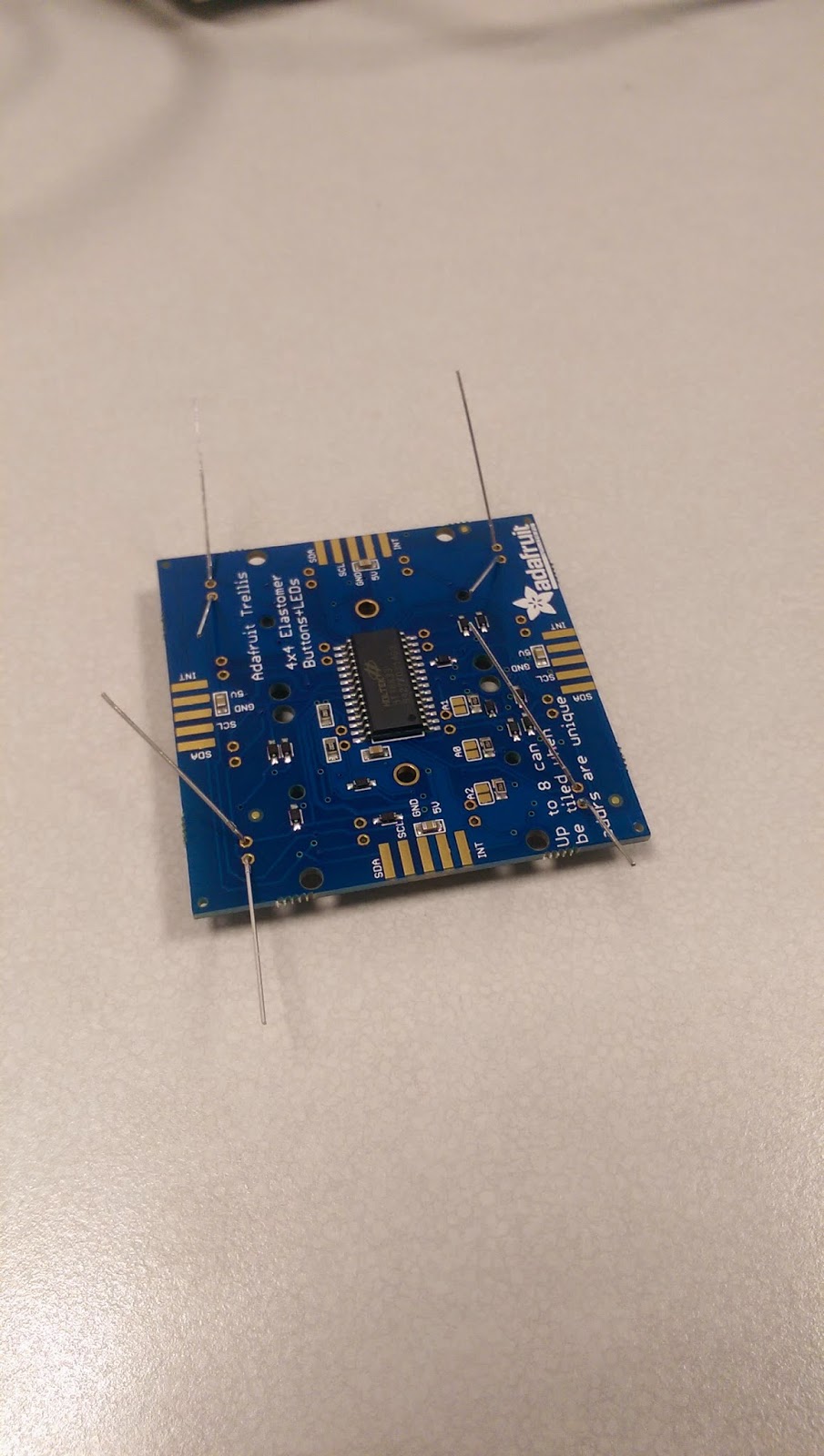
Some of the components that were used - 16 3mm LEDs in white and blue, Potentiometers (10k ohm), Male to male jumper cables, Adafruit Trellis board and silicone keypad.


I started by soldering the LEDs to the Trellis board. It was important to ensure the polarity of the LEDs was correct during this step or they would not work.


I soldered 16 LEDs onto an Adafruit Trellis board. With a silicone overlay, and uploaded a script to the Arduino Leonardo, this controls the turning on and off of the LEDs.


After tinning and soldering the contacts on the board (to connect to the Arduino leonardo).


To start with, I used a MakerBot 3D printer to print a box / container for the midi controllers components. This process took a few hours to complete but it was interesting to use the 3D printer.


After clipping down the potentiometers so they would fit in position.


In the correct positions.


Stripping the wire to connect up the potentiometers.


Here is where I started to wire in the potentiometers.


After wiring in the potentiometers, I tried to upload the code to turn the Arduino Leonardo into a MIDI controller - but ran into some issues verifying the code. I solved a few of the problems as the libraries were not installed properly, so moving some folders around fixed this, but was a long process figuring out the issues.

The original idea for this project was to create a midi controller purely for visuals, which could be strapped or attached to an instrument and used by the musician / performer to control visuals while playing / performing.

I had the idea for this project as not many musicians incorporate visuals in their performances - I wanted to make something easy to use and accessible by musicians.

This was partly inspired by a performance I saw last Summer. The band I saw, Nordic Giants, played various instruments which seemed to be connected to, or at least in sync with, a visual film which was placed at the front and centrally on the stage, shown through a projector. This film told a story as the bands set went on, and provided another focal point for the audience - it certainly made the performance more interesting to watch.


When I had finished the hardware aspect of the project, I realised the box was a little bulkier than I imagined. The box itself was really interesting to me as I found the shape and form really appealing. It seemed very cute. The way the LEDs were diffused through the silicon keypad was very endearing - it reminded me of raindrops.

Thinking about the way the box appeared, led me to create an idea around video gaming, as the box reminded me of a GameBoy - another clunky, but endearing piece of technology. This changed my idea in a way, and I decided to make the project a combined piece of technology (both audio and visual) - perhaps to accompany a musician, perhaps to be a solo performance mechanism. I created some musical tracks for twelve buttons, with the remaining four buttons on the pad to be used for visuals. The music I created was based on Chiptune, as I felt this fit well with the GameBoy aesthetic of the project.

The visuals were also inspired by the Chiptune aesthetic - I wanted to create something kitschy and retro looking.

One of the visuals.

I completed the hardware aspect of the project, but had some issues with the software side of things.

There were a few more errors which I eventually solved but I got stuck on one final error which I haven't been able to solve as of yet.


If I had had a bit more time, I would have liked to get everything working properly, and create a narrative through sound and visuals - so I could tell a story through music and images, much like the band mentioned above have done.

Monday, 17 November 2014

DAT 308 ~ Making Drum Samples


DAT 308 ~ Performance Interfaces

For this project we have been asked to create an interface which facilitates performance. We have a variety of software to help us create an interface which will produce an audio performance, visual performance, or both.

We came up with the idea of creating a wearable musical interface, which we are currently developing.

We are aiming to create this wearable musical interface which will allow the user to use their movement to generate a beat / musical scene.

At the moment our idea is to sew pressure sensors into or onto the shoulders of a blazer.

To generate the music we will be using Mozzi, a library for Arduino. We have tried to get the samples I created working but it appears that it will not be possible due to the memory of the Arduino - the musical tones will have to be produced on the fly.

Part of the inspiration for this piece was derived from the theatrical performance 'Stomp'.

<iframe width="560" height="315" src="//www.youtube.com/embed/tZ7aYQtIldg" frameborder="0" allowfullscreen></iframe>​

Thursday, 6 November 2014

DAT 306 ~ Extended Project Proposal


For my project I am going to create a simulator aiming to replicate the experiences of someone who is suffering from psychosis or a psychotic episode. To create this experience I will use an Oculus Rift Virtual Reality headset, with augmented reality elements depicting the potential visual experiences of psychosis, including ‘overlays’ added to the environment as well as visual disturbances. I will also use audio to add another dimension to the experience, which would demonstrate auditory hallucinations.

It may also be possible to simulate tactile hallucinations by the use of haptic feedback devices. To achieve this I will design and create at least one item of clothing which contains various motors and circuitry linked to an Arduino to provide a similar feeling to that of a common tactile hallucination. For example, the sensation of insects crawling on skin is an effect that I could somewhat replicate though the use of vibrating motors in a sequential placement, with one motor being activated, then the second and so on, so it feels like something is moving up an arm.

The immersive environment that I will be creating would be ideal for helping to encourage empathy, understanding, and relation in the general public or on mental health first aid courses. It could also be used by mental health professionals to gain a better understanding of what their clients may experience, which may mean that they are able to give more informed information to their clients. It could also help other students, and staff members gain an insight into how some peers and colleagues may experience their surroundings while experiencing psychosis.

My project would hopefully reduce instances of discrimination, harassment, and victimization – stigma and a lack of understanding is a common issue when it comes to mental health problems. My project aims to give people an understanding of what it is like to experience an episode of psychosis, and hopefully mean that people are more likely to be less judgemental when it comes to interacting with people who suffer from this condition.

By showing the impact and symptoms of psychosis, my project will help to show professionals involved in the care of a client how to best assist their client or student and give them equal opportunities in day to day life and in the academic environment.

In a more everyday environment, my project will allow the general population to understand psychosis. This will allow them to gain greater empathy and mutual understanding of how the person suffering from psychosis may feel in a variety of circumstances and situations.