With Augmented Reality, the lines between what is art, what is a commercial application, and what is an academic application are blurred - the technology is new, so the exploration of the topic is rather undefined. For example, all industrial applications could be perceived as somewhat arty and academic - it's hard to split the applications into distinct categories, as they are mostly interlinked. I'm going to be looking at a few various ways AR is used.
One commercial application of AR is the game for the PSP console, Invizimals. The objective of the game is to catch, level up, and battle creatures. The creatures are 'hunted' down by using a camera designed to be used with the PSP. The creatures are captured in the 'real world', with the camera taking the image in front of it (for example, your desk) and relaying it to the PSP's screen. Varying creatures are spawned, determined by the colour of surfaces and the time of day.
The creatures are 'captured' by placing a marker in front of the camera, on the creature.
Wednesday, 11 April 2012

Thursday, 5 April 2012
Pixel Art


The images are buttons for the game, particles for picking up items / transformations, a version of the bombed out church in Plymouth, a 'good' cat version, a 'bad' cat version, a poison bottle, and a cupcake.
Thursday, 15 March 2012
A New Plan
My rat detector doesn't work. I spoke to Simon recently and he gave me a great idea - what if the rat detector was a rat translator? I'm going to run with this idea and start researching about things that rats do, and what they are really (maybe) thinking. I have an idea for an old fashioned Victorian advert which I really want to make. I need to find a computer which can handle Photoshop. (Edit - done)
I probably ruined some of the components by soldering so slowly and overheating them.
I probably ruined some of the components by soldering so slowly and overheating them.
Friday, 9 March 2012
Making a Poster
I decided to make a poster for my 201 project. It's meant to be in the style of a Victorian poster.


I created a cream background. I applied clouds over the "paper" and added a border.


Here's how I did it.


To give the "paper" an aged look, I increased the colour levels in the clouds and applied more clouds over a corner of the page and increased their colour levels.

Added text and an image!

Monday, 5 March 2012
About Bat / Rat Detectors
As scientists have used bat detectors to listen to rats, I thought I would try to build my own. A bat detector is a piece of equipment which detects ultrasonic noises and then converts these noises into something that we can hear. By using a detector you can find out if bats are nearby.
They have a limited range of around 25 to 30 meters. Many bat detectors are able to detect a range of ultrasonic frequencies. When using them with rats, they work best within a couple of feet, as bats are far louder and generally bigger than rats. Using a bat detector inside can also be problematic as electrical appliances create lots of ultrasonic background noise.
http://bclee.net/ratdet.html
They have a limited range of around 25 to 30 meters. Many bat detectors are able to detect a range of ultrasonic frequencies. When using them with rats, they work best within a couple of feet, as bats are far louder and generally bigger than rats. Using a bat detector inside can also be problematic as electrical appliances create lots of ultrasonic background noise.
http://bclee.net/ratdet.html
Monday, 20 February 2012
Putting It Together
Over the weekend I started to make my bat / rat detector. I made a few mistakes like soldering the wrong components into the board but fortunately I had ordered extras so I didn't have to give up when this happened! It was fairly easy to melt the solder again and remove the wrong components. I just hope that I haven't overheated any components while soldering, some had 8 contact points through the board and I was pretty slow at soldering, and metal conducts heat very well. If I have runied some components, I hope I have enough spares to do them again.
All I need to do now is connect the headphone jack and mount the circuitry into the case. I used a dremel to drill holes into the case for the headphone jack and the ultrasonic transducer / microphone.


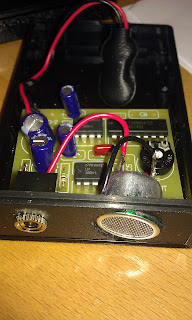
All I need to do now is connect the headphone jack and mount the circuitry into the case. I used a dremel to drill holes into the case for the headphone jack and the ultrasonic transducer / microphone.

This is the printed circuit board that I used. In this picture I've already added two [small components].

This picture is showing the soldeing process. You stick the 'prongs' of the component through the cirucit board and then use the soldering iron to heat the area around the component and then melt the solder onto the area.

Here is the board with nearly all of the components added. [list them]

Here is the back of the board which shows the soldering.

Here is the case with the circuitry in place. I drilled holes in the case using a dremel for the headphone jack and the transducer.
Monday, 13 February 2012
Rat's Laughter
This video is what first inspired me to look into listening to rats ultrasonic vocalisations.
It has now been proven that rats laugh. We cannot normally hear this though, as it is at a high ultrasonic frequency of around 50 kHz. Younger rats seem to be more susceptible to laughing, and they are generally more playful than older rats. It also seems that some rats are more playful and ticklish than others. The rats who enjoyed tickling would also seek out the human hands which had tickled them in the past. They also laughed less when around the smell of a cat, when too hungry, or around bright lights (rats prefer dim lights). In adults, it also seems that females prefer tickling to males, and that it is difficult for an adult rat who has never been tickled to start enjoying the behaviour. When young rats get to choose between adults, they prefer to spend time with the adult who 'laughs' more.It seems that rats laughter is distinct from their other ultrasonic vocalisations. They talk to each other, and only sometimes do we hear these vocalisations - for example when play fighting. By using a piece of equipment to listen to their usually unheard noises we can find out more about them.
In the paper called "Tickling-induced 50-kHz ultrasonic vocalization is individually stable " by Mallo et al. they mention that they studied low frequency vocalisations of rats:
and predicts behaviour in tests of anxiety and depression in rats
This shows that rats also have lower frequency vocalisations which are different to their higher frequency ones, and carry different meanings."We also studied the emission of low-frequency USVs in therange of 20-kHz, that have long been associated with negativeevents and stimuli and 50-kHz USVs and hence the emotional messages they carryare mutually exclusive or not, the associations between the twotypes of USVs were assessed, and no correlations were found."
http://blogs.scientificamerican.com/bering-in-mind/2010/08/03/laughing-rats-and-ticklish-gorillas-joy-and-mirth-in-humans-and-other-animals/
Subscribe to:
Posts (Atom)